Bayesian optimization for the design of laser-plasma accelerators
In laser wakefield acceleration, an ultra-short laser pulse ionizes a gas, forming a plasma, in which the laser beam drives a wave that can accelerate electrons up to GeV energies over centimetric-scale distances.
This phenomenon depends on many parameters and is highly non-linear, making it difficult to optimize. That is why, in simulations preparing an accelerator design for the new LAPLACE high-repetition-rate installation, researchers of LOA’s APPLI group used a machine learning process, Bayesian optimization, to guide high-fidelity quasi-3D particle-in-cell simulations.
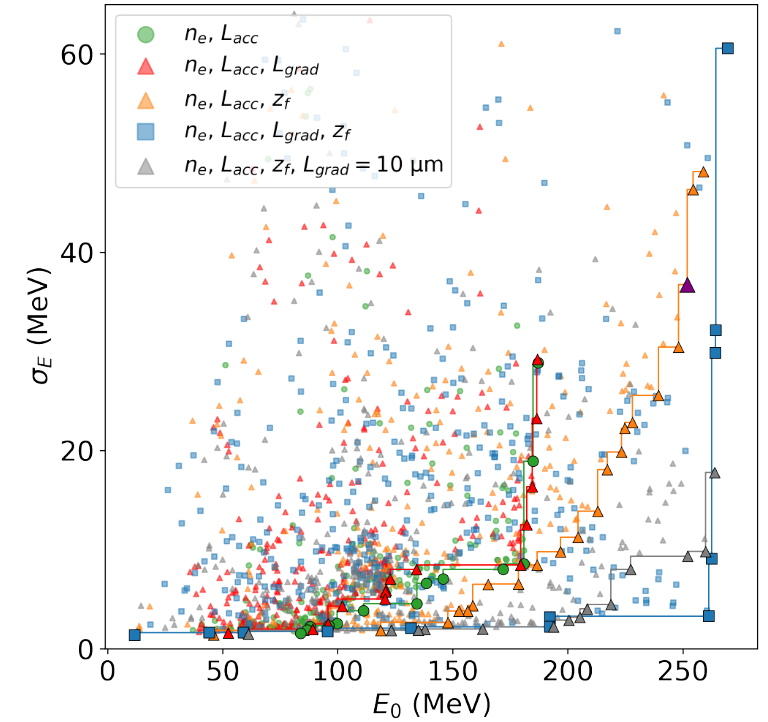
In their article just published in Machine Learning: Science and Technology, they analyze the influence of various parameters controlling the plasma density profile in order to maximize the mean energy and minimize the energy spread of the electron beam produced. In particular, they study the relevance of controlling the injection gradient and the exit ramp of the plasma density profile.
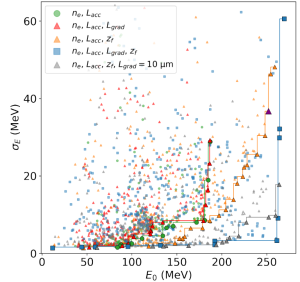
Figure: Each point represents a simulation; the x-axis showing the average energy of the electron beam, and the y-axis shows its energy spread. The beams are filtered: energy > 10 MeV, charge > 10% of the maximum. Each marker color indicates the parameter-space of the various optimization runs: ne is the electron density of the plasma, Lacc is the length of the density plateau following the shock (which corresponds to the acceleration phase), Lgrad is the length of the injection gradient, zf is the position of the laser focal plane.